Meteorology Charles A. Giannetta
Meteorologist - Professor
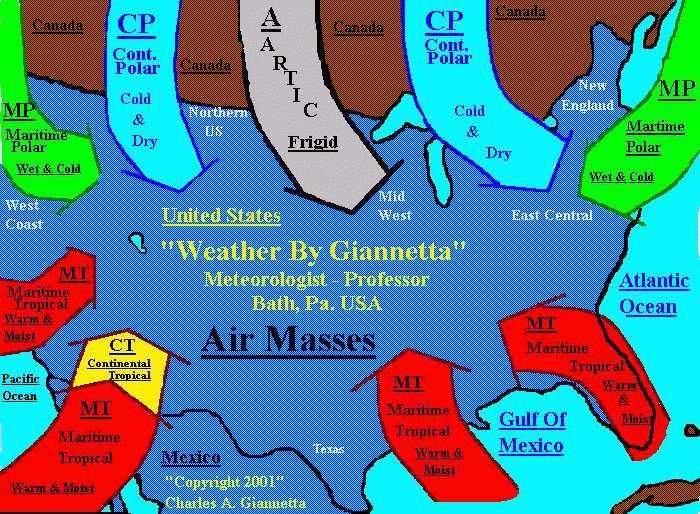
Air masses are classified as to whether they originate.
Over land or water, and if they originate over warm tropical
regions or cold polar areas.
| **Continental Polar (CP)** |
Continental Polar air forms over the high latitudes of North America,
Europe and Asia. This air mass has low surface temperatures, is
very stable, with low moisture. It contains
convective clouds, turbulence, good visibility, rain and snow showers,
and gusty winds.
Maritime Polar air masses orginate over the Polar regions and have the
properties of Continental Polar air. As this air mass moves south
and passes over warmer water, the air changes form cold air to warm air.
Maritime Polar air has characteristics of increasing temperature and humidity
as it passes over warm water. It is gusty with squalls, cumulus and
cumulonimbus clouds, skies are variable and change from very dark to bright,
with showery precipitation.
| **Maritime Tropical (MT)** |
Maritime Tropical air forms over oceans in the tropics. Gulf of Mexico
and the Caribbean. These air masses contain fog or mist, low stratus
clouds, poor visibility, high humidity, with rain and drizzle.
| **Tropical Continental (CT)** |
Continental Tropical air forms over the subtropics arid areas and is
very dry and hot. It has little importance in the United States. The
only regions are in western Texas , eastern New Mexico and northcentral
Mexico.
In the Eastern Hemisphere, Tropical Continental air masses are
prevalent and the source regions are in Northern Africa, and Southern Asia.
Arctic Air masses form over the Arctic regions of Siberia, Greenland and
North America, at about 60 degs. N. Lat. These air masses are very cold and
dry, and bring very cold air over the United States as far south as the Gulf
of Mexico and Florida.