Bath, Pa,
"N O T E"
All weather articles written by the author, weather records for Bath, Pa. USA, graphs,
graphics, pictures, are copyrighted and are owned by the author.
If you make use of data from this site, please make reference to the:
Station Licensee: Virginia T. Giannetta.
Owner - Author: Charles A. Giannetta. Computer Consultant: Charles E. Giannetta
& This Web Site. Thank you.
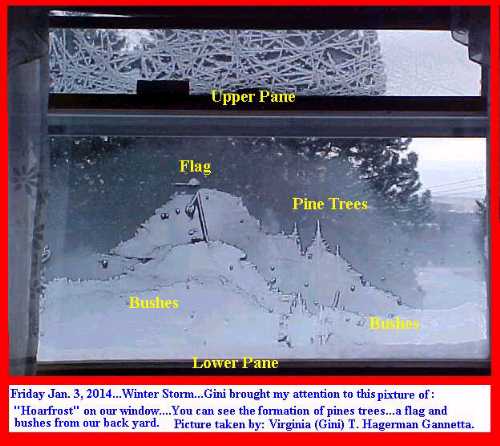
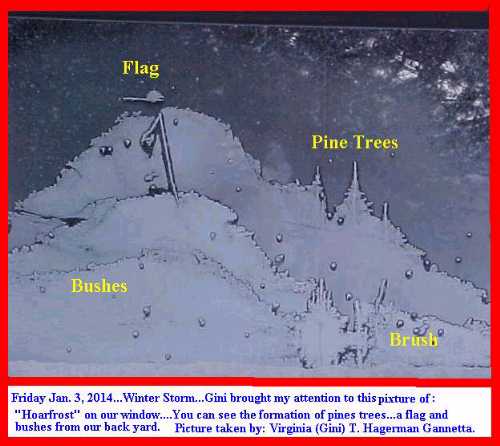
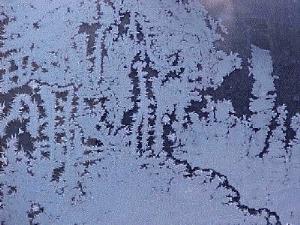
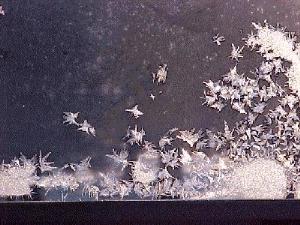
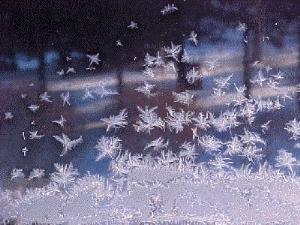
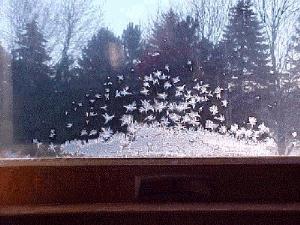
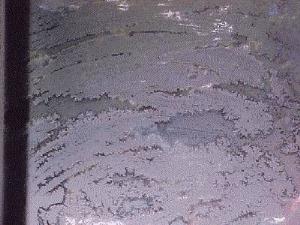
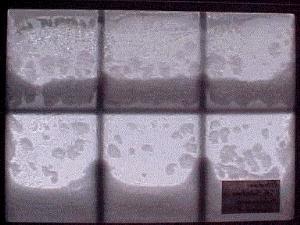
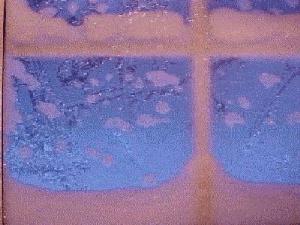
Friday Jan 3, 2014 "Winter Storm." My Wife Gini brought to my attention the
formation of "Hoarfrost" on our window. You can see the formation of
pine trees, bushes and a flag from our back yard. The pictures were taken by:
Virginia (Gini) T. Hagerman Giannetta. The temperature dropped to 8 degs. F.
8.3 inches of snow fall. Winds North West 20 to 30 mph. Blowing and drifting
snow...Frost is called: "Hoarfrost" when you have very cold temperatures.
and the frost forms. The patterns become picturesque as in these pictures.
The patterns are formed by minute dust/smoke/oil/cratches on the window.
The frost forms these beautiful patterns on the glass which can be seen
when the "Hoarfrost" forms.
**Frost**
One morning in the fall we wake to find a white coating on everything:
grass, rooftops, plants, cars and anything which got in it's way.
"What is it?" we ask. "Frost", someone says. Where did it come from?
How did it get here without us hearing it and waking us up?
Frost is a light feathery deposit of ice caused by condensation of
water vapor, directly in the crystalline form, on terrestrial objects
whose temperatures are below freezing. The process being the same as that
by which dew is formed, except dew occurs when the temperatures of the
bedewed object is above freezing.
The process whereby water changes from the vapor stage to the solid stage
bypassing the liquid stage, is called: "Deposition". The opposite process:
When water changes from the solid stage to a vapor stage bypassing the
liquid stage, is called: "Sublimation".
Frost is designated as light, heavy, or killing. LIGHT. Signifies one
which has no destructive effect to tender plants and vines. HEAVY. A
copious deposit but one which does not kill the staple products of the
locality. KILLING, sometimes referred to as "Black Frost. One which is
destructive to vegetation and staple products, and turns the vegetation
black.
My wife Virginia, Gini is a Cooperative Weather Observer. Since 1986,
Gini has been observing and recording max and min temperatures and
precipitation readings here in Bath. Looking over her records, the
earliest day in the fall of the season when the temperature dropped below
freezing was 30 degrees on October 4, 1996. The latest springtime reading
of below freezing was 28 degrees on April 23, 1989.
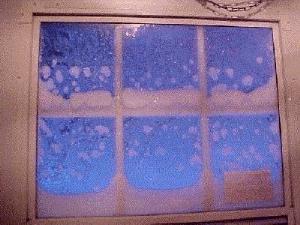
"Pictures Of Frost"

These pictures were taken by: Virginia (Gini) T. Hagerman Giannetta:
From windows in our house when he temperature reached below zero.
 -
-
 -
-
 -
-
 -
-
© 2013 Charles A. Giannetta
"N O T E"
graphics, pictures, are copyrighted and are owned by the author. If you make use of data from this site, please make reference to the: Station Licensee: Virginia T. Giannetta. Owner - Author: Charles A. Giannetta. Computer Consultant: Charles E. Giannetta & This Web Site. Thank you. |
|---|
|
Friday Jan 3, 2014 "Winter Storm." My Wife Gini brought to my attention the
|
|---|
| **Frost** |
|---|
"Pictures Of Frost"
© 2013 Charles A. Giannetta
These pictures were taken by: Virginia (Gini) T. Hagerman Giannetta:
From windows in our house when he temperature reached below zero.
-
-
-
-