Bath, Pa,
"N O T E"
All weather articles written by the author,
weather records for Bath, Pa. USA, graphs,
graphics, pictures, are copyrighted and are owned by the author.
If you make use of data from this site,
please make reference to the: Station Licensee: Virginia T. Giannetta.
Owner - Author: Charles A. Giannetta. Computer Consultant: Charles E. Giannetta
& This Web Site. Thank you.
**Lightning**
"N O T E"
All weather articles written by the author,
weather records for Bath, Pa. USA, graphs,
graphics, pictures, are copyrighted and are owned by the author.
|
|---|
**Lightning** |
|---|
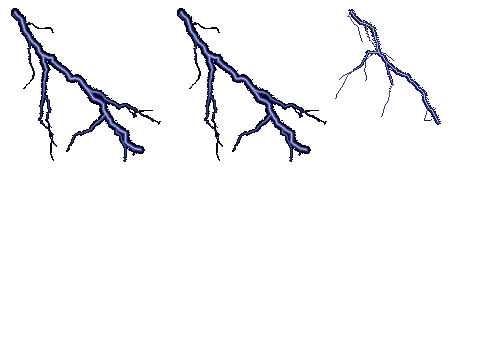
There are many descriptions of lightning, the most common is streak
lightning which appears zigzag in shape. Its look very much like
the outline of a river. It may be a single or multiple streaks, or may be
split up into smaller jagged branches.
Bead Lightning...Is a form of streak lightning. The appearance
of beads may be caused by variations in the brightness along the
path of the stroke.
Ribbon Lightning...Is streak lightning with numerous discharges
where the path of the lightning is blown sideways by the wind.
Fork Lightning...Describes strokes which have more than one path
to the ground.
Heat Lightning...Is streak lightning off in the distance too far
to hear thunder.
Sheet Lightning...A diffused, glowlike lightning whitish
in color, covering a considerable area in the clouds.
Ball Lightning...Visibly for a very short time, has been observed as
a bright ball, about 4 to 5 inches in diameter as it comes out of the clouds
at a very high speed, low to the ground, is reddish in color. Has been
observed as floating or in a stalled position. Visible for a short time,
dissappears quietly or with a loud noise.
Lightning is whitish in color, having the combined spectrum
of Oxygen and Nitrogen. It sometimes appears differently colored
against different backgrounds and surroundings in contrast to yellowish
artificial lights. Lightning may also appear bluish or reddish.
Lightning never stikes twice in the same place is false. Many flashes
of lightning are of the multiple variety and strike many times in a
few seconds. Tall towers often receive many strikes during thunderstorms.
Lightning strikes last only a few millionths of a second. The strikes
are made up of several pulses comimg so close together, our eyes cannot
always distinguish them. These fast pulses make lightning flashes seem to
flicker.
© 1998 - 2013 Charles A. Giannetta