Weather Glossary...WEATHER BY GIANNETTA...Giannetta. Charles. WA3RSQ. EL-NINO. Weather Magazines...Meteorology. Hurricanes. Tornadoes. Floods. Clouds. Radar. Forecasting. Thunderstorms. Lightning. Atmosphere. 69. Grand. Prix. Also WX DATA for Bath Pa.
This web site is dedicated in memory of: Laurie Elizabeth Giannetta. Twin Daughter"Weather By Giannetta"This web site is dedicated in memory of: Laurie Elizabeth Giannetta. Twin Daughter


"Charles A. Giannetta"
Meteorologist - Professor" Bath, Pa, USA.


- "This page best viewed with "Microsoft Internet Explorer". Text Size "Smaller"
Picture 1024 X 768 - 17 or 21 inch Monitor


Gini &Charlie's Weather & Meteorology Glossary - * * Gini & Charlie's Weather & Meteorology Glossary Page * * - Gini & Charlie's Weather & Meteorology Glossary

A |B |C |D |E |F |G |H |I |J |K |L |M |N |O |P |Q |R |S |T |U |V |W |X |Y |Z

Have Fun!!

"J"

January Thaw: A period of mild weather usually in late January.
Jet Max: The area of max wind speed within the jet stream.


Meteorology              Charles A. Giannetta
                         Meteorologist - Professor 
 
"Jet Streams & Weather"

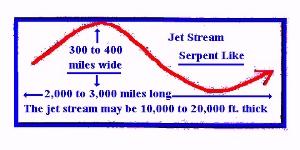
The jet streams are belts of high speed winds occurring at about 5 to 10 miles above the earth and may occur at higher or lower levels. These winds blow at speeds of 150 to 300 miles per hour. Speeds to 400 mph have been reported. The streams of high winds blow from west to east about the Northern Hemisphere. They may be 2,000 to 3,000 miles long. 300 to 400 miles wide and 10,000 to 20,000 feet thick as they serpentine around the globe. The jet streams were first encountered by military aircraft during World War II, but prior to that they were suspected to exist due to the observations of fast moving high cirrus clouds. Pilots flying west fly to avoid them, when flying east will try to fly along with the jet stream to get an added boost of speed. The jet stream moves from side to side around the earth wandering north and south depending on the season. In winter in the Northern Hemisphere they move south to blow hardest at about 30 to 35 degrees north latitude or over the United States area. In summertime the core of the jet stream lies about 40 to 45 degrees north latitude. Similar jet stream movements also appear in the Southern Hemisphere. Mush has been learned about the jet streams, but an exact explanation for their origin is still lacking. One theory is that the jet streams may form by coming together of larger streams of equatorial and polar air masses at great heights. When these cold and warm air masses are side by side, there is a resulting difference of pressure and temperature and may cause a strong circulation which becomes a jet. In North America, the North Atlantic and Europe, observations have been sufficient to detect jets and forecast their behavior. The jet streams are closely related to the polar front which separates tropical and polar air masses at about 60 degrees north latitude. The polar front is a continuous breeder of weather of the temperate zones. The jet stream seems to play an important part in the formation, steering and intensifying of weather phenomena such as cyclones, hurricane tracks and abnormal weather spells.


"Jet Winds"

1...Jet winds are caused by differences in temperature and or differences in pressure.
2...Jet Winds usually occur at heights of 30,000 to 60,000 feet on average.
3...Jet winds were first encountered by high flying aircraft during World War II.
4...Jet winds occur at speeds of 30 mph and can reach speeds of 400 mph.
5...The jet winds usually move form west to east, however, they do move north and south.
6...The jet winds in the summer time are usually located at about 45 degrees N. Lat.
7...During the winter months, the jet winds move as far south as Florida.
8...The jet winds maybe 500 to 3,000 miles long. 50 to 500 miles wide. ....5,000 to to 30,000 ft. in height.
9...The jet winds mover around the hemisphere in a "Snake-Like" maner.
10..The jet winds are also know as the Jet Stream.

"Copyright" 1998-2014 Charles A. Giannetta


Jet Winds: Also know as the "Jet Stream" are areas of winds 50 to 300 mph plus that appear in the atmosphere at 18,000 to 50,000 feet.
They maybe 500 to 3,000 miles long. 50 to 500 miles wide and greater than 10,000 feet thick and are steering currents in the atmosphere.

1. Jet Stream: Discovered during WW II over the Pacific. 2. Jet Stream. Jet Winds. Subtropical Jet Stream. 3. Jet Stream: Maximum. Jet Streak. Areas of highest wind speeds. 4. Jet Stream: Subtropical. Location. 18,000 feet to 40,000 feet. 5. Jet Stream: Wind speed: 50 mph to 400 mph. 6. Jet Winds: Called Iostachs on upper air charts.. 7. Jet Winds: Convergence & Divergence. 8. Jet Winds: Drawn as dashed lines on upper air charts. 9. Jet Winds: Move. W-E. N-S. S-N. Snake like.


The core of the Jet Winds.

Back To Top OF Page


© 1998 - 2013 Charles A. Giannetta

Back To Top OF Page

"Back To Home Page"

Weather Glossary...WEATHER BY GIANNETTA,Giannetta,Charles,WA3RSQ,EL-NINO,Weather,Magazines,Meteorology,Hurricanes, Tornadoes,Floods,Clouds,Radar,Forecasting,Thunderstorms,Lightning,Atmosphere,69,Grand,Prix, WXDATA,Bath,Pa,USA,CD ROM,Weather,Disk,Meteorology,Graphics,Research,weatherbygiannetta.com